Lessons Learned from the Doggy
By Maria Primachenko • 3 min read
Think twice when you ask for something.
I’D BEEN THINKING ABOUT HAVING A DOG for many years, and actually quite successfully visualizing what it would be like. I imagined how we would walk in the park, how we would sit together on the sofa, how we would play, and the sensations of petting the dog. I constantly bothered my family with my prompts: “Oh, just imagine if we had a dog, how great it would be!” and so forth.
What happened was not what I expected at all. It turned out to be a very interesting, actually spiritual, experience and a transformation for our whole family.
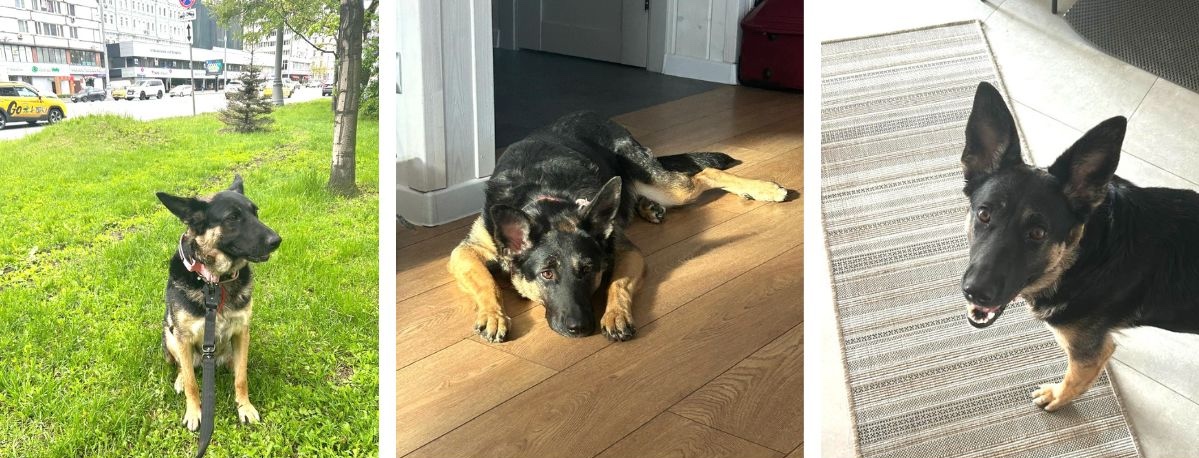
The dog, her name is Shanti, came unexpectedly and immediately turned everything upside down — all of our comforts, our settled routine, our expectations about what having a dog would be — everything. It was the end of summer, we were in the countryside, and suddenly, out of nowhere, a teenage German shepherd started running through the village. She was very unhappy, kind of growling, and very anxious. Probably someone had abandoned her.
The moment I saw her, I told myself, “No, I won’t do this.” But slowly, the situation unfolded in a way that I couldn’t ignore her misery. We tried to find her family and arrange care with volunteers, but nothing worked. So when we returned to the city a couple of weeks later, we made the difficult decision to take her with us.
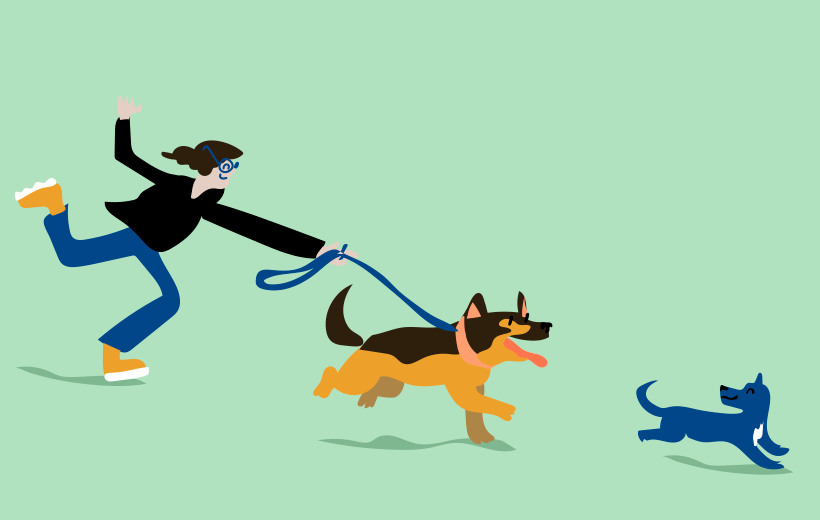
The city environment was very different for her. She immediately went into “monkey mind” mode, her mind stimulated by the cars, people, new smells, other dogs, or the delivery man… We live in the city center, where the traffic is quite intense. She barked, pulled, reacted, and often, we were just flying on the other side of the leash.
We thought, “Okay, we don’t have enough knowledge, we’ll work with dog trainers.” But that was also an illusion, an expectation that got turned upside down. We worked with at least five dog trainers, trying different methods, but nothing really worked. She remained reactive. No one could visit our place, and we couldn’t leave her alone because of her separation anxiety. She was like a very, very difficult teenager. I joked that we were quite blessed with our daughter, who didn’t give us a lot of trouble as a teenager, so this was our delayed training — with a doggy.
Daily life became more challenging. It was as if I’d unintentionally invited all these undesirable things into my life. Going outside became like a computer game where I had to be a super strategist, figuring out the best routes, and immediately changing direction if a dog or a deliveryman came into sight. I developed a completely new way of seeing the streets — and how to be super attentive. It reminded me of driving in India, where traffic is chaotic, and you have to pay attention every second.
At home, where we all wanted a quiet, peaceful, meditative space, it was suddenly very loud and restless. She was barking and going from one corner to another. We had to develop enormous patience every day. At some point, I thought I would break down. One dog trainer told us plainly, “Guys, you have to give up unless you want to spend a couple of years fully dedicated to socializing this dog. If you cannot do it, find another home for her.” We almost did.
“She was like a very, very difficult teenager. I joked that we were quite blessed with our daughter, who didn’t give us a lot of trouble as a teenager, so this was our delayed training — with a doggy. ” — Maria Primachenko
But somehow, we went through that stage. Eventually, I realized that the thing that works best — especially with all these uninvited circumstances that were driving us crazy — is actually to love. To love it. The moment I started opening my heart to this dog, loving her the way she is, not expecting her to be something else, embracing her anxiety and also her wild temper (because it’s also beautiful, there’s a very nice energy behind it), seeing her strong sides — she’s super smart — and building her confidence, that energy of love helped me to overcome the challenges.
Another lesson was recognizing that dogs are very emotional, highly developed beings. They can understand things without words. They can understand whole sentences, especially German shepherds, but they also understand our intentions and can read our minds — almost. Communicating with them is on another level altogether.
Shanti has also taught me about leadership. The moment I took her out and was weighed down by doubts and hesitations, she would feel it and start making decisions on her own. Usually, these decisions were not super helpful! I had to learn how to be confident, to show her that the leader knows what to do and that she can rely on my stability, my inner calm, and peace. Even in a triggering situation, she somehow relies on this state of my mind. This was not always the case. I had many times when I lost my patience, and immediately she became more agitated, more reactive. With a dog, you can feel this interdependence, especially if they rely on you as a leader.
Looking back, Shanti’s chaotic arrival was a perfect curriculum. Here is what she taught us:
Love as the Key:
When systems, trainers, and methods fail, unconditional love becomes the only true tool. It means embracing a being exactly as they are, with all their “flaws,” and seeing the beauty and potential within that truth.
The Practice of Being Present:
Walking with a reactive dog is a masterclass in mindfulness. It forces you into the present moment, requiring hyper-awareness of your environment and your own inner state. It’s a moving meditation in navigating chaos.
Interdependence is a Felt Truth:
We intellectually know we are connected, but a dog like Shanti makes you feel it. Her state was directly tied to ours. Our peace became her refuge; our chaos, her trigger.
Patience is Not Passive:
The patience required is not about waiting it out. It’s an active, daily recommitment — it’s choosing, again and again, to stay on the path even when there is no visible progress.
The Teacher Appears in Unexpected Form:
Our greatest spiritual challenges — our “Vajrayana training” — don’t always come from a human teacher or a book. They come as a scared, wild-hearted being who shatters our comfort zone, teaching us not to give up on love when things seem utterly undoable.
February 2026

Masha Primachenko turned to meditation to manage her anxiety and panic attacks. In 2012, she stumbled upon a YouTube video by Mingyur Rinpoche discussing panic attacks, and it really resonated with her. After meeting Mingyur Rinpoche in Bodhgaya in 2014, following his wandering retreat, she chose him as her main teacher. Masha is now a senior facilitator and one of the leaders of the Tergar Russia community. Professionally, she works in advertising and communication, currently serving as the Marketing and Communication Director for Tergar International. In her free time, Masha enjoys being outdoors with her family and traveling across India and Asia.
Learn meditation under the skillful guidance of world-renowned teacher Yongey Mingyur Rinpoche at your own pace.

“Compassion has a support team and never stands alone. It is infused with awareness that allows our hearts to be open and steady. When we feel connected, kindness naturally arises. With wisdom, we can see what’s happening clearly; we don’t try to do the impossible but see what we can do to meet the situation.”…

“Mindfulness meditation” is omnipresent these days. Some of these programs are based on traditional meditation practices, others are what you might call “New Age,” and others have been invented out of whole cloth. There exists at least one program claiming it will get you enlightened in seven days! But is mindfulness the same thing as…

In the midst of her mother’s devastating illness, Masha discovers unexpected gems of compassion, creativity, and presence.
If you enjoyed reading our articles, please join our mailing list and we’ll send you our news and latest pieces.




2026© Tergar International. The Tergar logo is a registered service mark of Tergar international.